
ECU Failing? Here’s Why You Probably Don’t Need a Full Replacement
If your car’s engine light won’t turn off, your dashboard is flickering, or your vehicle suddenly won’t start, the usual suspect is often blamed straight away: “It’s the ECU, you’ll need a new one.” For most drivers, that sounds like an expensive, non-negotiable repair bill. The good news is that in the majority of cases, it isn’t.
What Actually Is an ECU?
The Engine Control Unit (ECU) is essentially your car’s onboard computer. It manages fuel injection, ignition timing, emissions, and dozens of other functions that keep your engine running properly. Modern vehicles also rely on a whole network of related control modules — ABS controllers, body control modules, instrument clusters, and airbag/SRS systems — each handling a different part of the car’s electronics.
When any one of these fails, it can throw fault codes, disable functions, or in some cases stop the car from starting at all.
Why Dealerships Push Full Replacement
Dealer workshops are set up to swap parts, not repair them at component level. It’s faster for them to order a brand-new unit and reprogram it than to diagnose the actual fault on the circuit board. That’s convenient for them, but it usually means you’re paying for an entirely new part when the real problem is a single damaged component — a capacitor, a corroded connector, a cracked solder joint from heat or vibration.
The Repair Alternative
Most ECU and control module faults come down to identifiable, fixable issues at the board level:
- Water or heat damage — corrosion on the board from moisture ingress
- Blown components — capacitors or transistors that fail from voltage spikes
- Cracked solder joints — caused by years of engine vibration
- Connector damage — pins that have corroded or come loose over time
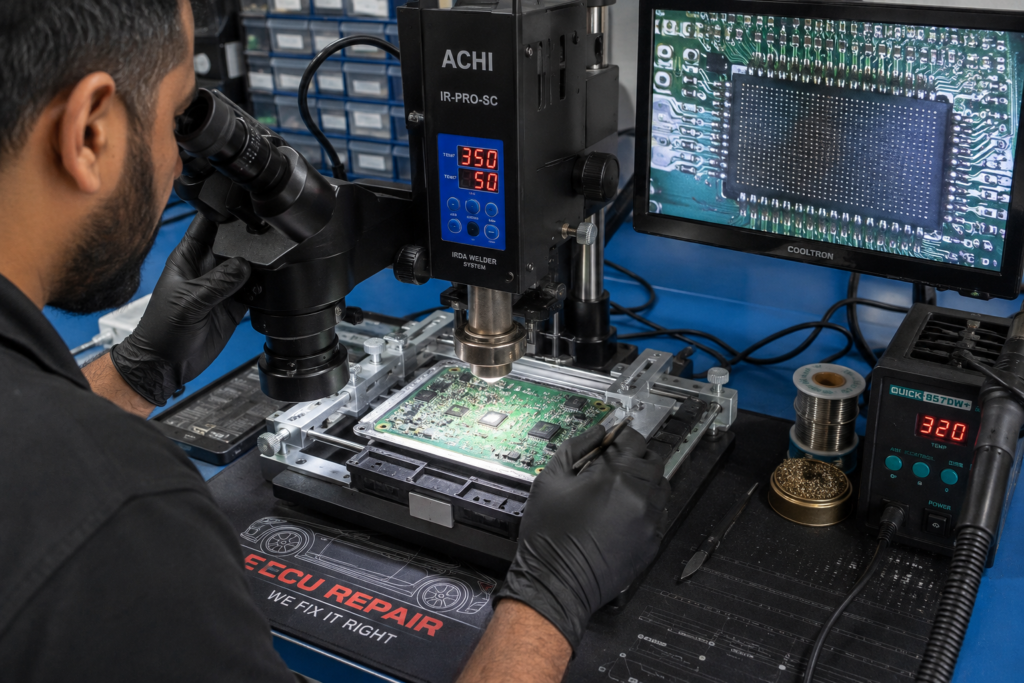
A trained technician can identify which specific component has failed and repair just that part — rather than replacing the whole board. This is the same micro-soldering skill set used to fix motherboards in phones and laptops, just applied to automotive electronics.
Signs You Might Have an ECU or Module Fault (Not a Mechanical One)
- Engine light on with no obvious mechanical cause
- Car cranks but won’t start, with no fuel or spark issue found
- Dashboard cluster flickering, dimming, or showing incorrect readings
- ABS or airbag warning light staying on after a mechanic has checked the physical components
- Intermittent electrical faults that come and go
If a mechanic has ruled out the physical parts (sensors, wiring, fuel system) and the fault persists, it’s worth getting the control unit itself diagnosed before paying for a replacement part.
What to Expect From an ECU Repair
- The faulty unit is diagnosed to find the specific fault
- You get a fixed quote before any repair work starts
- The board is repaired at component level
- The unit is fully function-tested before it’s returned
- The repair comes with a warranty
Repair costs are typically a fraction of a new or dealer-sourced replacement unit — and turnaround is usually just a few days.
Can’t Get to a Workshop?
You don’t need to visit in person to get this sorted. Most ECUs, clusters, and control modules can simply be removed from the vehicle and posted or couriered in for diagnosis and repair, then sent straight back to you.
The Bottom Line
Before you accept a quote for a brand-new ECU or control module, it’s worth getting the actual fault diagnosed at component level. In many cases, it’s a specific, repairable issue — not a reason to replace the whole unit.
Techlord Technology repairs ECUs, instrument clusters, ABS modules, and other automotive electronics at our Tauranga workshop — in person or by mail-in. 📍 299 Cameron Road, Tauranga 📞 07-571 6338 ✉️ repair@techlord.co.nz